
India and Russia are set to expand their defence cooperation, with India expressing interest in procuring additional S-400 missile systems. Discussions took place ahead of the India-Russia annual summit.

Russia's First Deputy Prime Minister Denis Manturov met with Indian leaders to discuss strengthening bilateral ties in key sectors amidst the escalating conflict in West Asia.

The visit was expected to project Assam as the gateway to Southeast Asia and reinforce the state's emergence as a preferred investment destination.

Prime Minister Narendra Modi and US Secretary of State Marco Rubio discussed various aspects of India-US bilateral ties, focusing on defence, trade, energy, and technology. Rubio extended an invitation from President Donald Trump for PM Modi to visit the US.

India and Tajikistan on Monday pledged to further deepen their cooperation to fight terror and agreed to step up defence ties besides boosting trade and investment.

Prime Minister Narendra Modi addressed the Indonesian parliament, emphasising India's commitment to development over expansionism and advocating for a free, open, and inclusive Indo-Pacific. He highlighted the strong historical ties between India and Indonesia, calling for enhanced cooperation in various sectors, including defence, technology, and counter-terrorism, amidst growing concerns over regional security.

Prime Minister Narendra Modi was accorded a grand welcome on his arrival in Jakarta on Monday, with Indonesian Air Force fighter jets escorting the PM's aircraft upon entering Indonesian airspace, marking a ceremonial welcome.

Pakistan's Prime Minister Shehbaz Sharif contacted Saudi Crown Prince Mohammed bin Salman to express solidarity amidst escalating regional tensions following attacks in Iran and the Gulf region.

A new report suggests China's maritime vulnerability lies in the Strait of Hormuz, not Malacca, creating strategic competition in the Indian Ocean.

In a region increasingly shaped by competition and coercion, such collaboration strengthens security without confrontation, builds capacity without dependency and promotes order without domination, points out Dr Kumar.

Notwithstanding the economic complementarities and the host of agreements for deepening economic relation on a host of areas, both sides share common viewpoints on the foreign policy domain and seek common grounds to serve as a counterweight to China, notes Dr Rajaram Panda.
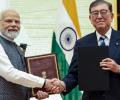
India and Japan have unveiled a comprehensive framework to boost their defence cooperation in response to security challenges, particularly concerning China's increasing military presence in the East and South China Seas.

A large-scale civil defence mock drill was conducted across Delhi, simulating a hostile attack scenario to test preparedness and response systems.

Over Rs 180 crore was incurred on Prime Minister Narendra Modi's visit to 23 countries including the US, the UK, France, China and Japan in 2025, according to data shared by the government.

Former US President Donald Trump stated that Gulf nations should reimburse the United States for safeguarding maritime traffic through the Strait of Hormuz, while asserting that recent American military interventions have profoundly crippled Iran's military capabilities, claiming Iran has been "brought back to the Stone Ages."
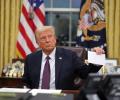
US President Donald Trump signed the National Defence Authorisation Act for Fiscal Year 2026 into law, highlighting broadened engagement with India and addressing the challenge posed by China in the Indo-Pacific region.

For India, the guiding principle should remain clear: Engage Bangladesh as a sovereign nation and society rather than through the prism of any individual leader or political party, suggests Manoj Mohanka.
US President Donald Trump has announced the cancellation of a planned attack on Iran, contingent on Tehran agreeing to rapidly open the Strait of Hormuz and end its nuclear programme. This decision follows appeals from Middle Eastern countries and includes Israel's commitment, though Iran had previously warned against any "adventurous action" from the US.

History may remember Takaichi Sanae not as the leader who simply accelerated Japanese rearmament, but as one who governed during Japan's transition from an industrial-age security model to a post-industrial strategic member of the global order, points out Varun Arya.

Prime Minister Narendra Modi's visit to Israel aims to strengthen the strategic partnership between the two nations, focusing on cooperation in various sectors including defense, technology, and trade.

Prime Minister Narendra Modi's visit to Italy concluded with the elevation of India-Italy relations to a Special Strategic Partnership, focusing on enhanced cooperation across various sectors.

Myanmar President U Min Aung Hlaing assured Prime Minister Narendra Modi that Myanmarese territory would not be allowed to be used against India's security interests, as the two leaders held wide-ranging talks to boost bilateral ties in trade, defence, and energy.

Admiral Samuel J Paparo, Commander of the US Indo-Pacific Command, lauded India's military restraint during Operation Sindoor and emphasized the growing India-US defence partnership aimed at maintaining peace and security in the Indo-Pacific region.

Under the defence partnership, India and the UAE are eyeing defence industrial collaboration and cooperation in advanced technologies, cyberspace training, special operations, interoperability of their militaries and counter terrorism.
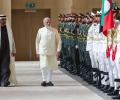
Prime Minister Narendra Modi has offered India's support to bring peace to West Asia during talks with UAE President Sheikh Mohamed bin Zayed Al Nahyan. Both countries signed agreements to strengthen strategic collaborations in energy and defence.

The United States military and Kuwaiti air defence forces successfully intercepted multiple Iranian ballistic missile and drone attacks targeting Kuwait and Bahrain, with Iran's state broadcaster claiming American military installations in Kuwait were deliberately targeted.

India and France have elevated their relationship to a 'special global strategic partnership,' with increased cooperation in defense, trade, and technology. The leaders also inaugurated a helicopter assembly line in Karnataka.

In an official statement, the embassy criticised remarks by the Russian foreign ministry, alleging that Moscow was attempting to manipulate information and interfere in India's internal processes.
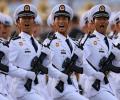
China's latest defence budget surges to $275 billion, fueling its ambitious military modernisation program and intensifying geopolitical dynamics in the region.

Beijing has been wary of Sanae Takaichi's efforts to boost Japan's military profile since taking office six months ago, points out Dr Rajaram Panda.

President Droupadi Murmu unveiled the Durand Cup 2026 trophy, marking the start of preparations for Asia's oldest football tournament. She highlighted the tournament's role in nurturing talent, promoting sportsmanship, and connecting people, while also drawing parallels to India's vision of becoming a developed nation.

Prime Minister Narendra Modi will visit the UAE, the Netherlands, Sweden, Norway and Italy to deepen India's bilateral ties amid geopolitical changes.

Indian startup funding plummeted by 43 per cent year-on-year to $7.81 billion between March 1 and June 15, 2026, largely due to the West Asia conflict, which has amplified global risk perceptions, tightened liquidity, and led to rupee depreciation, making global investors cautious.

External Affairs Minister S Jaishankar and US Secretary of State Marco Rubio discussed cooperation in trade, critical minerals, nuclear energy, and defence, reaffirming commitment to a free and open Indo-Pacific.

Prime Minister Narendra Modi urged US President Donald Trump to prioritise the safety of Indian seafarers in the Strait of Hormuz during the implementation of Washington's proposed Iran peace deal, as both leaders focused on repairing strained bilateral relations at the G7 summit.

Pakistan's Foreign Minister Ishaq Dar met with his counterparts from Egypt and Turkiye in Islamabad ahead of a quadrilateral summit, including Saudi Arabia, to discuss the ongoing conflict in West Asia and explore avenues for peace.
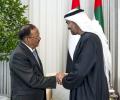
India is the only significant power that all parties trust, or at least do not distrust, notes former defence secretary Ajay Kumar.

Foreign secretary Vikram Misri on Friday shared key details on agreements between India and the UAE, stating that the UAE will store up to 30 million barrels of crude oil in India's strategic petroleum reserve following Prime Minister Narendra Modi's visit.

Pakistan has deployed a military contingent, including soldiers and fighter jets, to Saudi Arabia as part of a joint strategic defence agreement aimed at enhancing military coordination and regional security.
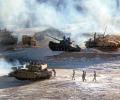
While tensions have eased at several friction points and mechanisms for managing the boundary have been reactivated, underlying differences persist. Disputes over naming practices in Arunachal Pradesh, continued infrastructure development on both sides, and unresolved questions regarding patrolling rights indicate that the structural gap remains, notes Dr Kumar.
